If your business has ever received a GST show cause notice that throws around words like “fraud” or “suppression” without actually explaining what was hidden, a recent Supreme Court ruling is worth reading closely. On August 26, 2026, in Tata Steel Limited v. Union of India, the Court struck down a GST demand built on exactly that kind of notice — and in doing so, drew a sharp line between a genuine fraud case and a department simply trying to buy itself extra time.
The Short Version
The GST department issued Tata Steel a notice under Section 74 of the CGST Act — the provision meant for cases involving fraud, willful misstatement, or deliberate suppression of facts. The problem: by the time the notice was actually issued, the ordinary three-year window under Section 73 had already closed. The only way the department could still act was to dress the case up as a Section 74 matter, since that provision buys two extra years. The Supreme Court was not convinced, and threw the notice out — along with the tax order that followed it.
Why Section 73 vs Section 74 Actually Matters
GST law gives officers two very different roads to raise a demand for short-paid tax or wrongly claimed input tax credit (ITC), and the road they choose changes both how long they have to act and how much penalty lands on the taxpayer.
| Aspect | Section 73 (Ordinary Cases) | Section 74 (Fraud / Suppression Cases) |
|---|---|---|
| When it applies | Genuine error or difference of opinion — no fraud alleged | Fraud, willful misstatement, or deliberate suppression of facts |
| Limitation period | 3 years from the due date of the annual return | 5 years from the due date of the annual return |
| Maximum penalty | 10% of the tax due, or ₹10,000 — whichever is higher | Up to 100% of the tax amount |
| What the department must show | That tax was short-paid or ITC wrongly claimed | The above, plus specific facts proving fraud, misstatement, or suppression |
Because Section 74 hands the department two extra years and a much heavier penalty, there is an obvious temptation to reach for it even in ordinary cases — especially once the normal three-year clock has already run out. This case is about the Court refusing to let that temptation slide.
How the Case Unfolded
The dispute traced back to an audit by the Comptroller and Auditor General (CAG), which flagged alleged mismatches in Tata Steel’s ITC claims and possible short payment of tax across three financial years: 2018-19, 2019-20, and 2020-21. Rather than acting on it right away, the department initially parked the matter in what is informally called the “call book” — essentially a holding pen for cases the department isn’t actively pursuing. It was only revived later, close to the limitation deadline, as what the Court described as a protective demand.
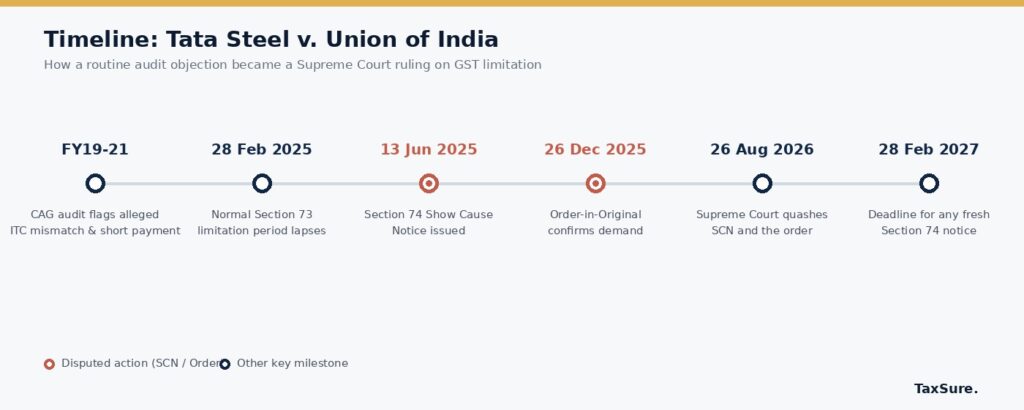
| Date / Period | What Happened |
|---|---|
| FY 2018-19 to FY 2020-21 | Financial years covered by the CAG audit objection |
| During audit cycle | Matter placed “under call book” by the department, then later revived |
| 28 Feb 2025 | Normal Section 73 limitation period lapses (after accounting for COVID-era relief) |
| 13 Jun 2025 | Section 74 Show Cause Notice issued — months after the Section 73 window had closed |
| 26 Dec 2025 | Order-in-Original passed, confirming the demand |
| 26 Aug 2026 | Supreme Court sets aside both the notice and the order |
| 28 Feb 2027 | Deadline for the department to issue any fresh Section 74 notice, if properly justified |
What Each Side Argued
| The Department Said | Tata Steel Said |
|---|---|
| Proceedings began before the ordinary limitation period expired | By the time the actual notice was issued, the ordinary three-year period had already lapsed |
| There was suppression of material facts and willful misrepresentation | The notice never specified what facts were allegedly suppressed, or how |
| A now-omitted explanation to Section 74 still justified the extended period | That explanation had been removed from the law well before the notice was issued |
| — | Parking the matter in the call book, then reviving it as a protective demand, shows the department never had genuine conviction about fraud in the first place |
How the Supreme Court Reasoned Through It
The limitation clock had already run out
The Court worked through the applicable dates, including the limitation relief every taxpayer got from the pandemic (the Supreme Court’s own earlier order excluding the period from March 2020 to February 2022 from limitation calculations). Once that adjustment was applied, the ordinary three-year window for all three financial years closed by February 28, 2025. The notice, dated June 13, 2025, arrived well past that point — meaning Section 73 alone could no longer save it.
Saying “fraud” doesn’t make it fraud
This is really the heart of the ruling. The Court held that before invoking Section 74, an officer has to be genuinely satisfied — based on real, specific facts — that fraud, willful misstatement, or suppression actually happened. That satisfaction has to be visible in the notice itself, not just implied by using the right legal vocabulary. A notice that mentions ITC discrepancies and adds a generic line about missing documentation, without ever describing what was concealed or how, simply does not meet that standard. Mechanically inserting words like “suppression” into a notice, the Court made clear, cannot substitute for actually establishing it.
A shelved file tells its own story
Two other facts weighed against the department. First, it had once placed the entire matter in the call book — hardly the behaviour of an officer convinced that deliberate fraud was underway. Second, the department had separately gone on to contest the CAG’s own audit objection before the Public Accounts Committee, effectively disputing the very basis the audit had flagged. Taken together, the Court read this as evidence that the department’s belief in fraud was, at best, thin.
The Outcome
The Supreme Court set aside both the Show Cause Notice dated June 13, 2025, and the Order-in-Original dated December 26, 2025. This was not, however, a blanket ban on the department revisiting the matter — it left the door open for a fresh Section 74 notice, but only one that lays out concrete, specific facts of fraud or suppression on its face, and only if any resulting order is passed by February 28, 2027.
A notice cannot borrow five years of extra time by simply reciting the words fraud and suppression without ever showing its work.
— summarising the Court’s reasoning, in our own words
What This Means If You Run a Business
- Read any Section 74 notice line by line: does it actually describe what was suppressed and how, or does it just use the word?
- A notice that lands suspiciously close to (or after) the ordinary three-year deadline, but is framed as a fraud case, deserves a closer legal look before you respond.
- This ruling gives taxpayers a genuine, citable ground to challenge notices that treat “fraud” as a limitation-extension trick rather than a real finding.
- It will likely push departments to draft more carefully going forward — but until that happens fully, this defence is very much alive for anyone facing a similar notice.
Facing a Section 74 Notice? Get It Reviewed Before You Reply
A GST notice invoking fraud or suppression is not something to answer on instinct — the wording of the notice itself can decide whether the extended limitation period even applies. TaxSure’s compliance team reviews Section 73 and Section 74 notices for exactly this kind of gap before advising on a response.
Leave a Reply
We value your thoughts and would love to hear your perspective.