As of May 11, 2026, the Indian Goods and Services Tax (GST) framework has transitioned from its formative years into a high-precision, technologically enforced regime. For tax professionals and corporate leaders, the current fiscal year (FY 2026-27) represents a watershed moment. With gross GST collections crossing the ₹2.22 lakh crore milestone in March 2026—an 8.3% year-on-year growth—the government’s focus has shifted from revenue expansion to absolute compliance integrity.
This research-based analysis explores the three pillars currently redefining GST operations: the mandatory Invoice Management System (IMS), the aggressive lowering of e-invoicing thresholds, and the judiciary’s evolving stance on procedural fairness.
1. The Invoice Management System (IMS): The End of “Passive” ITC
The introduction of the IMS (fully operational as of early 2026) has fundamentally altered the Input Tax Credit (ITC) lifecycle. Gone are the days when a taxpayer could simply wait for GSTR-2B to populate and claim credit.
The “Deemed Acceptance” Trap
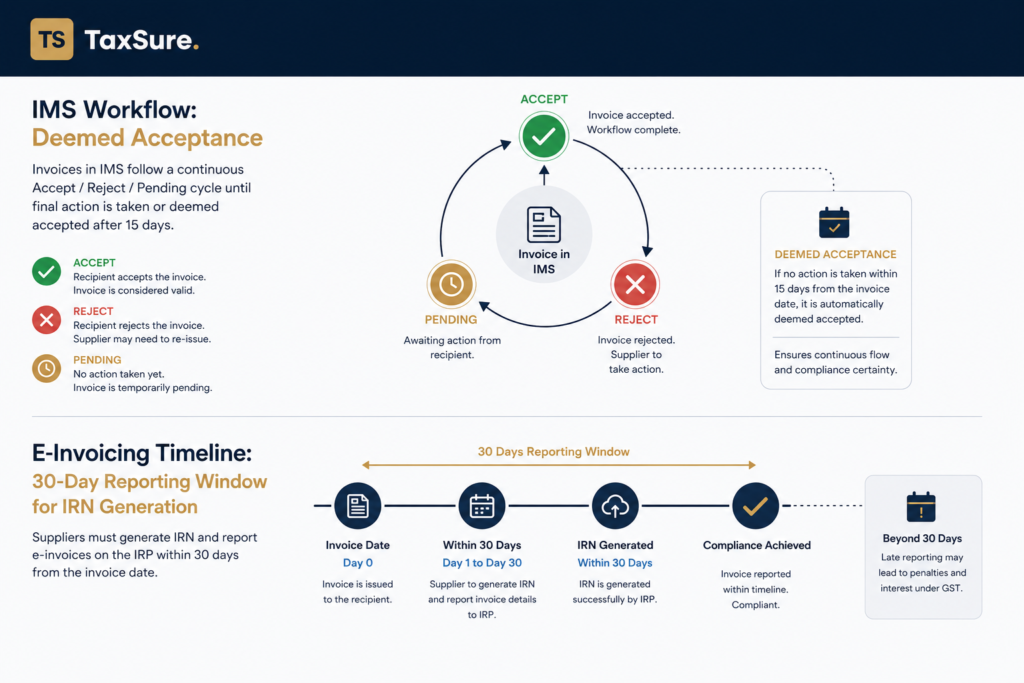
The IMS functions as a real-time gatekeeper. Every invoice uploaded by a supplier now requires a proactive action from the recipient: Accept, Reject, or Pending.
- Data Insight: Current GSTN metrics indicate that approximately 30% of mismatches are now caught at the IMS stage before they ever hit a return.
- Critical Constraint: If no action is taken, the system applies a “Deemed Acceptance” rule. While this ensures credit flow, it also means that fraudulent or incorrect invoices are auto-validated into your books, shifting the entire burden of “due diligence” onto the recipient under Section 16(2)(aa).
Structural Timeline for May 2026
For monthly filers, the window to act on the IMS dashboard for the April 2026 period closes precisely as the GSTR-2B is generated on the 14th of every month. Any invoice marked “Pending” is rolled over to the next month, but if the supplier’s filing is not finalized, the credit remains frozen, impacting immediate liquidity.
2. E-Invoicing Expansion: The ₹5 Crore Threshold Impact
Effective April 1, 2026, the e-invoicing threshold was lowered to include businesses with an Aggregate Annual Turnover (AATO) exceeding ₹5 crore in the preceding financial year.
The 30-Day Hard-Stop
Perhaps the most significant technical hurdle for the mid-market segment is the 30-day reporting window for businesses with an AATO ≥ ₹10 crore.
- The Rule: Any B2B invoice, credit note, or debit note must be reported to the Invoice Registration Portal (IRP) within 30 days of the document date.
- The Penalty: Failure to generate an IRN within this window renders the invoice legally invalid for ITC purposes. Research into April 2026 filing trends shows a 12% spike in rejected ITC claims due to “Time-Barred IRN Generation.”
Professional Advisory: For businesses currently at the ₹5 crore threshold, the risk is not just the ₹10,000 penalty per invoice; it is the commercial fallout when your B2B customers find their ITC blocked due to your non-generation of an IRN.
3. Revenue Trends and the “Zero-Mismatch” Enforcement
The government’s “Zero-Mismatch Policy” is now enforced through System-Level Hard Blocks. As of May 2026, the GST portal prevents the filing of GSTR-3B if the ITC claimed exceeds the GSTR-2B availability by even a nominal margin.
FY 2025-26 Performance Summary
| Metric | FY 2024-25 | FY 2025-26 | Growth (%) |
| Gross GST Collection | ₹20.18 Lakh Cr | ₹22.27 Lakh Cr | 8.3% |
| Avg. Monthly Collection | ₹1.68 Lakh Cr | ₹1.85 Lakh Cr | 10.1% |
| Total Refunds Disbursed | ₹2.48 Lakh Cr | ₹2.92 Lakh Cr | 17.8% |
The 17.8% surge in refunds highlights the efficiency of the new automated refund processing for exporters and Inverted Duty Structure (IDS) cases, though this is offset by the increasing rigor of pre-refund audits.
4. Judicial Maturation: Substance Over Form
While the GSTN portal is becoming more rigid, the Judiciary in 2026 is providing a necessary counter-balance. Recent rulings from the Bombay and Calcutta High Courts (April 2026) have emphasized that “Procedural technicalities cannot override substantive justice.”
Key Legal Trends for 2026:
- Consolidated SCNs: Courts are increasingly questioning the validity of a single Show Cause Notice covering multiple financial years, citing that it hampers a taxpayer’s ability to provide a period-specific defense.
- Digital Rights: The recognition of digital data (Excel sheets, Tally backups) as “Relied Upon Documents” (RUDs) means the department must provide full digital copies to the taxpayer before adjudicating a demand.
- Bona Fide Purchases: A landmark shift is emerging where courts are protecting buyers who have made “bona fide” purchases and payments, even if the supplier later defaults on their tax deposit—provided the buyer can prove rigorous use of the IMS.
Conclusion: The May 2026 Compliance Checklist
For the current filing cycle ending May 20, 2026, organizations must ensure:
- IMS Finalization: All “Pending” invoices from April are either accepted or rejected before the GSTR-3B filing.
- IRN Verification: Validate that all B2B supplies for April have a valid IRN, specifically checking against the 30-day reporting limit.
- HSN Accuracy: Ensure 6-digit HSN codes are present on all invoices (mandatory for AATO > ₹5 Cr).
The “Good and Simple Tax” has evolved into a “High-Tech and High-Precision” tax. Success in this environment requires moving away from reactive monthly filing toward daily reconciliation and real-time vendor management.



Leave a Reply
We value your thoughts and would love to hear your perspective.