Introduction
When unlisted companies raise capital through a preferential allotment under Section 62(1)(c) of the Companies Act, 2013, the pricing of those shares is tightly regulated. Generally, the issue price must be determined based on a comprehensive valuation report from an Independent Registered Valuer registered with the Insolvency and Bankruptcy Board of India (IBBI).
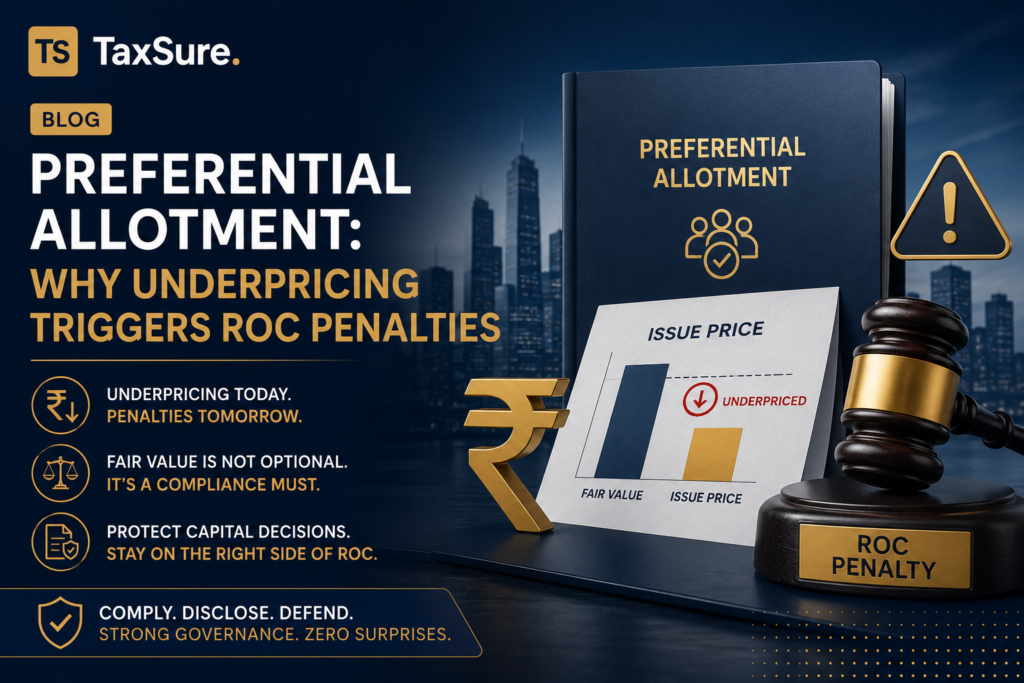
A recent adjudication order by the Registrar of Companies (RoC), Karnataka, serves as a critical reminder for corporate boards: the statutory pricing floor is absolute. Even a fractional underpricing resulting from standard rounding-off practices can trigger non-compliance, resulting in hefty penalties that subsequent rectification cannot erase.
The Core Legal Framework
To understand the compliance threshold, two key provisions must be read together:
- Section 62(1)(c) of the Companies Act, 2013: Governs the increase in share capital through a preferential basis to identified persons.
- Rule 13(3) of the Companies (Share Capital and Debentures) Rules, 2014: Explicitly mandates that the price of shares to be issued on a preferential basis shall not be less than the price determined on the basis of the valuation report of a registered valuer.
Case Analysis: In re Netanalytiks Technologies Limited
1. The Facts of the Case
- The Valuation: The company appointed an IBBI-registered valuer who assessed the fair value of the equity shares (Face Value of ₹10/- each) at ₹334.59 per share.
- The Corporate Action: Assuming that fractional pricing could be rounded off to the nearest whole rupee, the Board and Shareholders approved the allotment of 16,766 equity shares at ₹334 per share in March 2022. The return of allotment was subsequently filed with the RoC.
- The Discovery & Rectification: Realizing the technical breach later, the management moved quickly to rectify the error. By February 2025, the company successfully recovered the differential amount of ₹0.59 per share along with 12% interest from the allottees.
- The Voluntarily Action: Believing that a proactive approach would mitigate risk, the company filed a suo-motu adjudication application before the RoC, Karnataka, admitting the technical default.
2. The Issues Before the RoC
- Does issuing shares at a price lower than the valuation report, even by a fractional margin (e.g., ₹0.59), constitute a strict violation of Section 62(1)(c)?
- Does subsequent recovery of the differential capital (with interest), filing a suo-motu application, and the absence of mala fide (bad faith) intent absolve the company of liability under Section 450?
3. The Adjudication and Ruling
Despite the company’s transparency and quick rectification, the RoC maintained a strict stance:
- Strict Interpretation of Rule 13(3): The RoC held that the wordings of the law leave no room for rounding down. Allotting shares at ₹334 instead of ₹334.59 is an absolute violation, regardless of the nominal quantum of the shortfall.
- Rectification Doesn’t Erase the Default: The RoC observed that subsequent financial recovery does not retroactively erase the initial statutory non-compliance.
- Penalties Imposed: Because Section 62 does not carry a specific penal provision for this exact breach, the omnibus penalty section—Section 450 of the Act—was invoked. The RoC imposed a base penalty of ₹10,000 each on the company and its officers-in-default, alongside continuing default penalties, resulting in an additional ₹2,00,000 for the company and ₹50,000 for the officers.
Key Takeaways for Corporate Boards
| Common Corporate Assumption | Actual Statutory Reality |
| Fractional share values can be rounded down to the nearest rupee. | False. Shares must never be priced lower than the exact valuer figure. Rounding up is permissible; rounding down is a violation. |
| Making a suo-motu disclosure and paying back the shortfall removes the penalty. | False. Suo-motu applications show good faith but only act as a mitigating factor; they do not erase the initial liability. |
| If shareholders face no loss and consent, the transaction is safe. | False. Procedural compliance under the Companies Act is independent of shareholder satisfaction. |
TaxSure Insights & Recommendations
A Message to Our Clients:
When executing capital restructuring or preferential issues, precision is paramount. To ensure your company remains fully compliant, always implement the following safeguards:
- Always Round Up: If a valuation report results in a fraction (e.g., ₹334.59), always round the issue price up to the next whole number (₹335) or keep it at the exact decimal. Never round down.
- Pre-Allotment Audits: Ensure your legal compliance team or consultants verify the absolute alignment between the definitive valuation report and the Board Resolution drafts before the meetings are convened.
For expert guidance on corporate secretarial practices, share premium valuations, or managing RoC adjudication matters, feel free to reach out to our compliance team at TaxSure Consultancy.
Disclaimer: This article is for informational purposes only and does not constitute formal legal or professional advice.


Leave a Reply
We value your thoughts and would love to hear your perspective.